

Please follow & like us

Merseyrail services affected by industrial action

El Pollock / Merseyrail Class 507, 507010, Birkenhead North railway stationDue to planned 24-hour strikes by Network Rail staff who are members of the RMT union, Merseyrail will be running a limited train service on Tuesday 13th, Wednesday 14th, Friday 16th and Saturday 17th December.

While Merseyrail staff are not part of this industrial action, it will involve Network Rail staff who operate the signalling systems and provide maintenance support.

As a result, a 45-minute service will run between approximately 07:30 and 18:30 on strike days.

A summary of services that will operate is as follows:

  • Southport line: Trains will run every 45 minutes, calling at all stations.
  • Ormskirk line: Trains will run every 45 minutes, calling at all stations.
  • Kirkby line: Trains will run every 45 minutes, calling at all stations.
  • Chester and Ellesmere Port lines: No trains will operate between Chester and Rock Ferry or Ellesmere Port and Rock Ferry. Trains will run every 45 minutes between Rock Ferry and Liverpool Central, calling at all stations.
  • New Brighton line: Trains will run every 45 minutes, calling at all stations.
  • West Kirby line: Trains will run every 45 minutes, calling at all stations. 
  • Hunts Cross line: No trains will operate between Liverpool Central and Hunts Cross.

You can find links to strike day timetables here.

Please note: There will be no rail replacement buses on strike days and passengers are advised to make alternative travel arrangements if you cannot make your planned journey using the train service that will operate.

Thursday 15 December – Early Morning Services

On Thursday 15 December trains will be reintroduced from 06:50. First train times can be viewed on the Merseyrail website.

To help customers get into the city centre, early morning rail replacement buses will run as follows:

Southport line:

  • Southport 05:45 calling at Formby 06:15, Waterloo 06:35 and Moorfields 06:55.
  • Formby 06:00 calling at Waterloo 06:20 and Moorfields 06:40.

Ormskirk line:

  • Ormskirk 06:00 calling at Maghull 06:20 and Moorfields 06:50.

Kirkby line:

  • Kirkby 06:00 calling at Fazakerley 06:10 and Moorfields 06:40.

Chester & Ellesmere Port line:

  • Chester 06:00 calling at Bache 06:10 and Moorfields 06:50.
  • Hooton 06:00 calling at Rock Ferry 06:30 and Moorfields 07:00.

West Kirby line:

  • West Kirby 06:00 calling at Birkenhead North 06:20 and Moorfields 06:50.

New Brighton line:

  • New Brighton 05:45 calling at Birkenhead North 06:05 and Moorfields 06:35.
  • Moorfields 06:35 calling at Hamilton Square 06:50 and Birkenhead North 07:00.

Hunts Cross line:

  • Hunts Cross 06:00 calling at Liverpool South Parkway 06:10 and Moorfields 06:35.
  • Moorfields 06:35 calling at Liverpool South Parkway 07:05.
  • Liverpool South Parkway 07:10 calling at Moorfields 07:35.
  •  

If you have assisted travel bookings or require assisted travel between strike days please contact us here, or use the National Passenger Assist App.
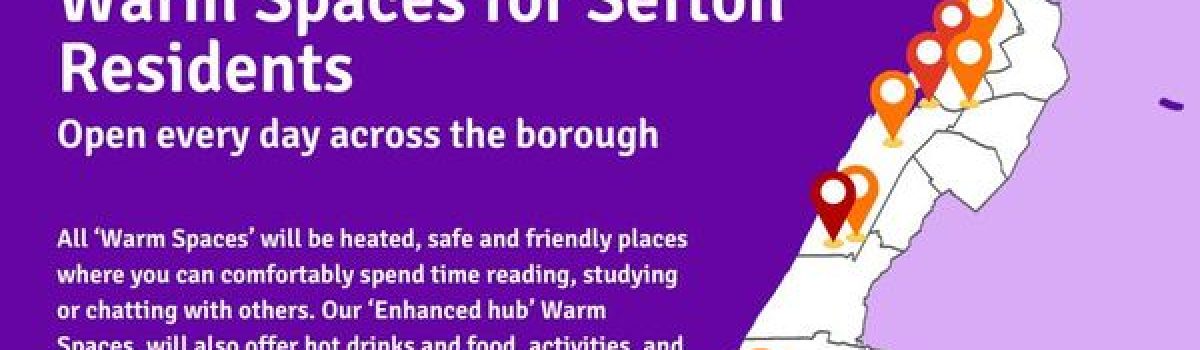
Warm spaces for Sefton residents

Flyer for Sefton's Warm spaces networkSefton residents facing a difficult winter because of soaring fuel bills and rising prices in the shops, now have a network or Warm Spaces available across the Borough where they can go without the fear of what they are spending on gas and electricity.

Sefton Warm Spaces include libraries, community centres, luncheon club, charities and places of worship. They are open on different days and at different times with some in the mornings, some in the afternoons and some stretching into the evening.

When and where

To make it easy for people to find their local Warm Space there is a web page at https://seftoncvs.org.uk/warmspaces which contains details of each day by day as well as an interactive map showing the locations across the Borough. 

All ‘Warm Spaces’ are heated, safe and friendly places where people can comfortably spend time reading, studying or chatting with others. Some venues, called ‘Enhanced’ Warm Spaces, will also offer hot drinks and food, activities, and other services such as free Wi-Fi. All Sefton Council libraries offer free computer and Wi-Fi access.

Sefton’s network of Warm Spaces has been coordinated by the Council and Sefton Council for Voluntary for Service (CVS).

They have also drawn up a Sefton Warm Space Charter, which guarantees everyone will get a warm welcome, will be treated equally with dignity and respect and has a right to be warm in a safe space. The Charter also states that organisers will not tell anyone about people needing a Warm Space and that it doesn’t matter why people need to be there.

You can find out the details of Sefton’s Warm Spaces network here.

Real fear

When the Warm Spaces opened in November, Cllr Trish Hardy, Sefton Council’s Cabinet Member for Communities and Housing said: “Fortunately, we have had a mild autumn so far but as the weather gets colder, I am pleased that in partnership with Sefton CVS and groups and organisations across the Borough, we now have this network of Warm Places.

“Sadly, they will be much needed by those people across the Borough who are in real fear of putting on their heating in this national cost of living crisis.”

Essential support

Angela White OBE, Chief Executive of Sefton CVS said: “Sefton’s voluntary, community and faith (VCF) sector have come together to provide essential support to Sefton residents across the borough through the warm spaces initiative in these challenging and unprecedented times. Working in partnership with Sefton Council, Sefton CVS and the VCF sector, community spaces will be made available during the Winter to provide warmth, companionship, information and community support.

“Looking out and caring for our local residents and communities is vital when so many are feeling so worried and isolated.”

Proud

Cllr Hardy added: “While I am so proud of the way that groups and organisations have stepped up to meet this challenge, I am dismayed that in one of the richest countries in the world, we are having to put in place measures that help people in Sefton with the cost of simply surviving.”


Keeping warm and well in the cold weather

Person in a blanket sneezingBad weather can be a hazard for vulnerable people or those with long term health conditions.

Warnings

With weather warnings in place and frosty temperatures forecast for this week, Sefton residents are being asked to look out for their relatives, friends and neighbours, and to follow the NHS advice on keeping safe and well.

Keep warm

If you are aged 65 or have long term conditions such as heart or kidney disease, diabetes or breathing conditions, try to keep warm by heating your home to at least 18°C (65°F). You should also wear several layers of light clothes to keep warm, as multiple layers will trap warm air better than one bulky layer of clothing.

Keeping warm over the winter months can also help us all to prevent colds, flu and more serious health problems such as heart attacks, strokes, pneumonia and depression. Have at least one hot meal a day and have hot drinks regularly. Sefton has a Warm Spaces programme, with locations for individuals and families to visit to keep warm throughout the winter. You can view an interactive map and daily timetable of Warm Spaces across the borough as well as more information about the initiative at www.seftoncvs.org.uk/warmspaces.

If you do go outside during, cold, wet and windy weather, remember to wear shoes with a good grip to prevent slips and falls. If possible, stay inside during a cold period if you have heart or respiratory problems.

Be prepared

Ensure you have stocked your cupboards with food and medications in advance, to avoid going out in the bad weather. There are a variety of items available at your local pharmacy that you can have at home to keep healthy and treat minor illnesses, such as pain relief medications, lozenges, cold and cough syrups, antihistamines, and much more.

Cold weather can also increase your risk for respiratory infections such as flu and COVID-19 and getting vaccinated is the best protection against both viruses. It’s important to get both vaccines when you’re eligible.

Susanne Lynch MBE, head of medicines management for Sefton, said: “Help and advice is available from local pharmacies in Sefton, and through programmes such as Care at the Chemist where you can get treatment for minor illnesses without the need to visit your GP first.

“Cold weather can impact your health so it is important to check in on everyone in our local communities and if you do become ill we ask that you think about self-care, contacting NHS 111 for non-emergencies and speaking to your local pharmacist.”

Where to get help

If you have an urgent medical problem, but not an emergency, get help from NHS 111 by visiting: www.111.nhs.uk online, or calling 111. You can also access NHS advice and information at www.nhs.uk.

For urgent consultations, advice and treatment for minor injuries and illnesses in both children and adults, the Litherland urgent treatment centre on Hatton Hill Road is open 7 days a week from 8am until 8pm. You can make an appointment via NHS 111, or walk in without an appointment.

For treatment and medications without the need to visit your GP, the Care at the Chemist scheme is available in 31 participating pharmacies across Sefton, for common illnesses and conditions such as coughs, colds, fever, headaches, sore throat and many more. The medicines are prescribed free of charge for anyone who does not pay for their prescriptions. Those who do pay will be charged the current prescription charge, or lower if they are cheaper to buy over the counter.

If you are worried about keeping warm and paying your fuel bills you can contact the Council’s Affordable Warmth Service on 0151 934 2222 or the local Energy Advice Freephone line on 0800 043 0151.

Angela White OBE, chief executive of Sefton CVS said: “During the upcoming cold weather, we encourage everyone to look out for one another in our communities, especially for vulnerable residents and neighbours or those living alone.

“Encourage anyone vulnerable to come along to our network of Warm Spaces available across Sefton over the winter months for those who may be struggling to heat their homes. Some sites offer a ‘basic’ warm space whilst others offer an ‘enhanced’ warm space with food and activities.

“If you’re worried about a relative or an elderly neighbour, contact your local council or ring the Age UK helpline on 0800 678 1602.”

Find out about Sefton’s network of Warm Spaces.


New Sefton Council officers now working to ensure Borough’s private tenants are benefiting from energy standards legislation

Wall mounted thermostatSefton Council’s two new Minimum Energy Efficiency Standards (MEES) Compliance Officers are now in post.

Helping landlords

Their role is to work with landlords to help them ensure any properties they let meet the national MEES requirements. This will mean helping landlords understand their responsibilities under MEES and advising them on funding that may be available to help them meet them.

MEES Regulations set a minimum energy efficiency level for domestic private rented properties, which must have an energy performance certificate (EPC) rating of E or above.

Properties with a lower F or G EPC rating cannot be rented out without a valid exemption. Landlords who don’t comply with these regulations can face fines of up to £5,000.

Grant funding

Cllr Trish Hardy, Sefton Council’s Cabinet Member for Communities and Housing said: “With people’s fuel bills rocketing, it’s vital that tenants in private rented accommodation that properties are fuel efficient.

“Our new officers have now started to work with landlords to ensure they are meeting the requirements of MEES Standards in place, including how they can find help with grant funding.

“However, in the longer term, if landlords are unwilling to support their tenants in this way by complying with the legislation, they will be able to take enforcement action.”

Competition

Sefton Council secured the funding for the MEES officer by participating in the Private Rented Sector (PRS) Domestic Minimum Energy Efficiency Standard (MEES) Compliance and Enforcement Competition. The competition supports local authorities to raise awareness of the PRS Regulations to both landlords and tenants as well as building capacity to tackle the identification of non-compliant landlords. The funding can also be used to support local authorities to create processes to enforce the PRS Regulations.

The £6.3 million competition is funded by the Department for Business, Energy & Industrial Strategy (BEIS) and managed by the Midlands Net Zero Hub.

The second round of the PRS MEES competition saw a further 26 local authorities receive funding to improve the energy efficiency standards of domestic properties in the private rented sector. This iteration builds on the success of the previous scheme, which saw 59 local authorities supported.

You can find more information about Minimum Energy Efficiency Standards here.  


UKHSA update on scarlet fever and invasive group A strep

Group A strep virus cellsData from UK Health Security Agency show that scarlet fever cases and group A streptococcus (GAS) cases continue to remain higher than would typically be seen at this time of year in the North West.

Scarlet fever is usually a mild illness, but it is highly infectious.

Symptoms

This means you should look out for symptoms in your child, which include a sore throat, headache, and fever, along with a fine, pinkish or red body rash with a sandpapery feel. On darker skin the rash can be more difficult to detect visually but will have a sandpapery feel.

Contact NHS 111 or your GP if you suspect your child has scarlet fever, because early treatment with antibiotics is important to reduce the risk of complications such as pneumonia or a bloodstream infection. If your child has scarlet fever, keep them at home until at least 24 hours after the start of antibiotic treatment to avoid spreading the infection to others.

Rare circumstances

Dr Merav Kliner, Deputy Director, UKHSA North West, said:  “We are seeing a higher number of cases of group A strep this year than usual in the North West. The bacteria usually causes a mild infection producing sore throats or scarlet fever that can be easily treated with antibiotics.

“In very rare circumstances, this bacteria can get into the bloodstream and cause serious illness – called invasive group A strep (iGAS). This is still uncommon however it is important that parents are on the lookout for symptoms and see a doctor as quickly as possible so that their child can be treated and we can stop the infection becoming serious.

“Make sure you talk to a health professional if your child is showing signs of deteriorating after a bout of scarlet fever, a sore throat, or a respiratory infection.”

Bacteria

Scarlet fever is caused by bacteria called group A streptococci. These bacteria also cause other respiratory and skin infections such as Strep throat and impetigo.

In very rare occasions, the bacteria can get into the bloodstream and cause an illness called invasive group A strep. While still uncommon, there has been an increase in invasive group A strep cases this year, particularly in children under 10.

Investigations are also underway following reports of an increase in lower respiratory tract group A strep infections in children over the past few weeks, which have caused severe illness.

No evidence

 Currently, there is no evidence that a new strain is circulating. The increase is most likely related to high amounts of circulating bacteria and social mixing.

 There are lots of viruses that cause sore throats, colds and coughs circulating. These should resolve without medical intervention. However, children can on occasion develop a bacterial infection on top of a virus and that can make them more unwell.

Parents

As a parent, if you feel that your child seems seriously unwell, you should trust your own judgement.

Contact NHS 111 if or your GP if:

  • your child is getting worse
  • your child is feeding or eating much less than normal
  • your child has had a dry nappy for 12 hours or more or shows other signs of dehydration
  • your baby is under 3 months and has a temperature of 38C, or is older than 3 months and has a temperature of 39C or higher
  • your baby feels hotter than usual when you touch their back or chest, or feels sweaty
  • your child is very tired or irritable

Call 999 or go to A&E if:

  • your child is having difficulty breathing – you may notice grunting noises or their tummy sucking under their ribs
  • there are pauses when your child breathes
  • your child’s skin, tongue or lips are blue
  • your child is floppy and will not wake up or stay awake

Good hand and respiratory hygiene are important for stopping the spread of many bugs. By teaching your child how to wash their hands properly with soap for 20 seconds, using a tissue to catch coughs and sneezes, and keeping away from others when feeling unwell, they will be able to reduce the risk of picking up, or spreading, infections.

Group A Strep – What you need to know (UKHSA)

Search Box